How a Winter Walk Solved A Writing Problem
Dear Vi,
One of the story ideas I’ve got simmering on my brain’s back burner is set in a fictional town beside the Stewart River in Canada’s Yukon Territory. So far I only have the setting, but it’s important to me that the setting should almost be like character in the novel, not just a generic backdrop.
Every now and then, I sit down and write a short scene or vignette to help me build this new place in my imagination, and a couple of months ago, I’d been trying to describe the moment a character looks up and sees the start of the autumn migration of Sandhill cranes passing overhead.
The Writing Problem I Couldn’t Solve
Did you know that Sandhill cranes are one of the oldest living species of bird on the planet? Sandhill cranes are one of the closest thing to living dinosaurs we’ve got. They don’t sound like modern birds, nor do they fly in the tidy, aerodynamic Vs of geese or swans. Sandhill cranes fly in ragged, multiple Vs, like a handful of jacks scattered across the sky (if jacks were shaped like a short v).
Except I didn’t want to use a kid’s game to help me paint the picture. I wanted to find a way that would reflect the particular landscape of the sub-arctic. Something organic to the boreal forest—that the boreal forest itself would recognize.
I had the sound of the cranes and the blueness of the October sky, but I didn’t have a way to translate what the migration looked like onto the page in a way that satisfied me.
If you ‘re a writer too, you’ll understand how knowing a thing so precisely but not being able to find the language to describe it is a very particular type of “argh” frustrating.
The Answer Was Outside All Along
And then one day it just…happened.
Bella and I were out walking, and she stopped to sniff around the base of a birch tree. I waited patiently because our walks are as much for her as for me. And while I waited, my gaze wandered up into the canopy of branches.
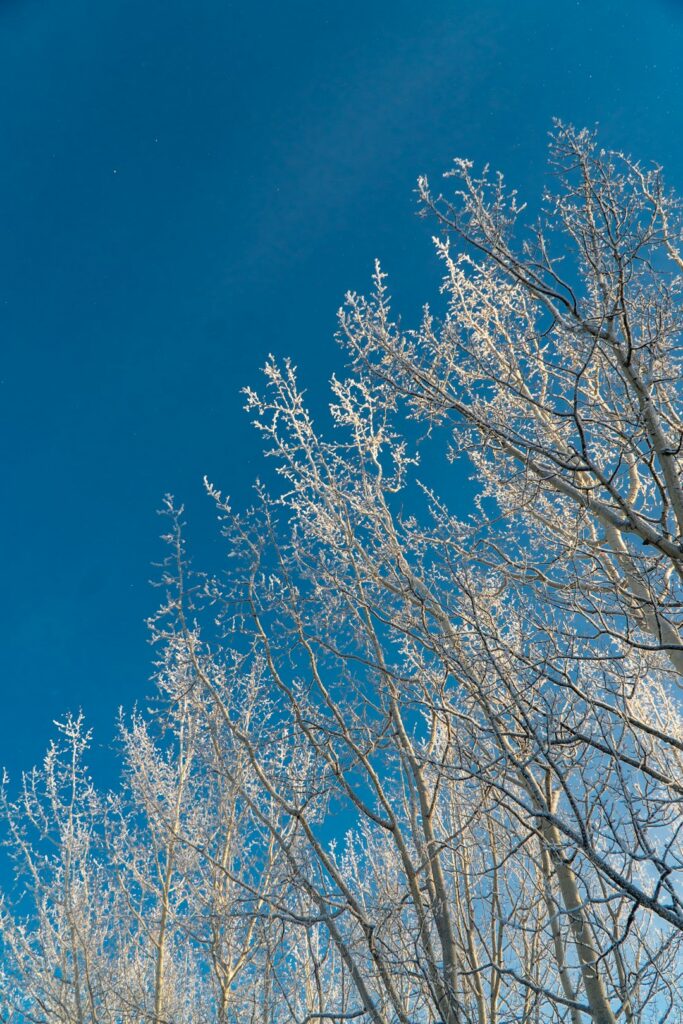
It was February, the depths of winter. The tree was bare of leaves, and her bald canopy stood out in sharp contrast against the deep blue of the Yukon winter sky. Main branches branched into smaller ones, and then branched again, and then again, each twig throwing off smaller twigs in every direction.
Those branching twigs looked exactly like the ragged Vs of Sandhill cranes in migration.
Twigs have twigs have twigs is what I wrote in my journal when I got home, along with a sketch of what the shapes looked like against the sky.
How to See What You Need to See
I didn’t come up with that comparison while sitting at my desk, I’d simply gone outside and stopped long enough to look up and notice. The image I needed had been there all along, in the branches of an ordinary birch tree on an ordinary walk. I don’t know if I needed to learn how to see it, or if I just needed to let myself relax enough to see it. Or maybe they are part and parcel of the same?
Creative Walking for Writers
That moment of seeing Sandhill cranes in the forking twigs of a birch tree is where the idea for a membership course I’ve started to develop was born: Creative Walking for Writers.
More on that soon.
But in the meantime — have you ever found something on a walk that solved a problem at your desk? I’d love to know.
Tell me in the comments, or just hit reply. I read and respond to everything.